
Resistance Bands for Weight Loss at Home | SendSlim
- Home
- Resistance Bands for Weight Loss at Home | SendSlim
Resistance Bands for Weight Loss at Home | SendSlim
Can Resistance Bands Help You Lose Weight at Home?
You do not need a gym membership or expensive equipment to start a healthy exercise routine. Resistance bands are simple, affordable tools that can help you build muscle and burn calories right in your living room. They come in different tension levels, making them a good fit for beginners and experienced exercisers alike. When combined with healthy eating habits, regular resistance band workouts may support your weight loss goals over time.
Exercise is one important piece of a weight management plan. The Centers for Disease Control and Prevention (CDC) recommends that adults get at least 150 minutes of moderate-intensity activity each week, along with muscle-strengthening activities on two or more days. Resistance bands can help you meet both of those goals without leaving home.
How Resistance Bands Help with Weight Loss
Resistance bands work by creating tension against your muscles as you move. This tension forces your muscles to work harder than they would without resistance. Over time, this helps build lean muscle mass. More muscle in your body means your metabolism works slightly faster, even when you are resting. This is sometimes called your resting metabolic rate.
Burning calories is a key part of weight management. A resistance band workout can burn a meaningful number of calories depending on the intensity and duration. Research published in the Journal of Human Kinetics found that resistance training can increase calorie burn both during and after exercise, a phenomenon sometimes called excess post-exercise oxygen consumption (EPOC). This means your body continues to burn extra calories for a period of time after your workout ends.
Unlike heavy free weights, resistance bands are low-impact. This makes them easier on your joints. People who experience knee or hip discomfort often find resistance bands a more comfortable option for staying active.
Types of Resistance Bands and How to Choose One
There are several types of resistance bands available. Loop bands are flat circles of rubber often used for lower body exercises like squats and lateral walks. Tube bands come with handles and work well for upper body movements like bicep curls and rows. Flat therapy bands are wider and are often used in physical therapy and stretching routines.
Resistance bands come in different tension levels, usually labeled by color. Lighter tension is best when you are just starting out. As you get stronger, you can move up to a band with more resistance. Many starter kits include several levels so you can progress over time.
When choosing a band, look for one made from durable latex or latex-free material if you have allergies. Check that the band has no visible cracks or tears before each use to avoid snapping during exercise.
Effective Resistance Band Exercises for Weight Loss
A well-rounded routine should work muscles in your upper body, lower body, and core. Here are some effective exercises you can try at home:
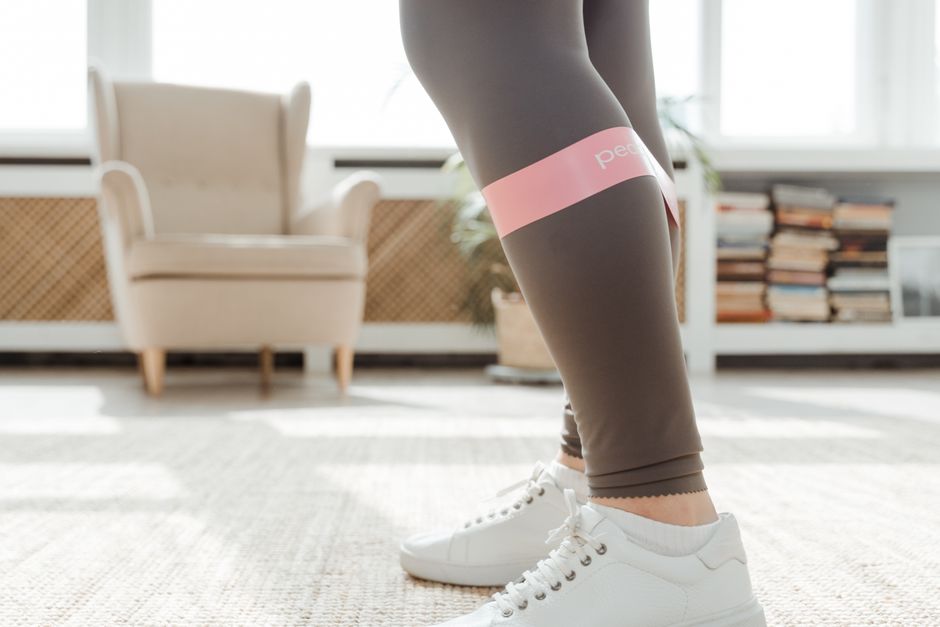
- Squats with a loop band: Place the band just above your knees. Stand with feet shoulder-width apart and squat down slowly. This works your thighs, glutes, and core.
- Banded rows: Sit on the floor with legs extended. Loop a tube band around your feet and pull the handles toward your chest. This strengthens your upper back and arms.
- Standing bicep curls: Stand on the middle of a tube band and curl the handles up toward your shoulders. This targets the front of your upper arms.
- Lateral band walks: Place a loop band around your ankles. Step side to side while staying low in a slight squat. This works your hips and outer thighs.
- Glute bridges with a band: Lie on your back with the band across your hips. Push your hips up toward the ceiling and squeeze. This activates your glutes and lower back.
- Standing overhead press: Stand on the band and press the handles straight overhead. This works your shoulders and upper arms.
Aim to complete two to three sets of 10 to 15 repetitions for each exercise. Rest for 30 to 60 seconds between sets. As exercises become easier, increase the resistance or add more sets.
Building a Weekly Routine
Consistency matters more than perfection. A practical approach is to schedule three to four resistance band sessions per week, with rest days in between. On rest days, light walking or stretching can keep you active without overstressing your muscles. Rest is important because muscles repair and grow stronger during recovery time.
You can also combine resistance band training with other forms of activity. For example, a 20-minute resistance band circuit followed by a 20-minute brisk walk is an efficient way to meet weekly activity recommendations. Mixing strength training with cardiovascular activity tends to support weight management more effectively than doing only one type of exercise.
Tracking your workouts in a simple notebook or phone app can help you see progress over time. Noting how many reps you completed or which band level you used gives you useful data to build on each week.
Pairing Exercise with Medical Guidance
Exercise is most effective for weight management when it is part of a broader plan that includes nutrition and, in some cases, medical support. A licensed clinician can help you understand which approach fits your health history and goals. If you are in California or Nevada, SendSlim offers convenient video and phone visits with licensed clinicians for just $50 per visit, with no insurance required. This makes it easy to get professional guidance without traveling to a clinic.
Some people may also benefit from prescription weight loss medications alongside lifestyle changes. A clinician can assess whether medication is appropriate for you and monitor your progress safely. Exercise alone may not be enough for everyone, and that is completely normal. A personalized plan that combines movement, nutrition, and medical support is often more effective than any single approach on its own.
Conclusion
Resistance bands are an affordable, flexible, and joint-friendly way to add muscle-building exercise to your daily routine at home. Regular strength training can support calorie burning, improve muscle tone, and contribute to overall health. By building a consistent weekly routine and pairing it with good nutrition and medical guidance when needed, you give yourself a strong foundation for long-term weight management. If you want support along the way, SendSlim makes it simple to connect with a licensed clinician from the comfort of your home.
References
- Centers for Disease Control and Prevention. “How Much Physical Activity Do Adults Need?” CDC.gov. 2023.
- Westcott, Wayne L. “Resistance Training is Medicine: Effects of Strength Training on Health.” Current Sports Medicine Reports. 2012.
- Paoli, Antonio, et al. “Resistance Training with Single vs. Multi-joint Exercises at Equal Total Load Volume: Effects on Body Composition, Cardiorespiratory Fitness, and Muscle Strength.” Frontiers in Physiology. 2017.
- Donnelly, Joseph E., et al. “American College of Sports Medicine Position Stand: Appropriate Physical Activity Intervention Strategies for Weight Loss and Prevention of Weight Regain for Adults.” Medicine and Science in Sports and Exercise. 2009.
- Manini, Todd M., and Brian C. Clark. “Dynapenia and Aging: An Update.” Journal of Gerontology: Medical Sciences. 2012.
Ready to start your medical weight loss journey?
Talk to a licensed clinician by phone or video — from anywhere in California or Nevada. No waiting room. No insurance needed. Just $50 per visit.
Individual results vary. Medication is only prescribed when clinically appropriate.
- Share
